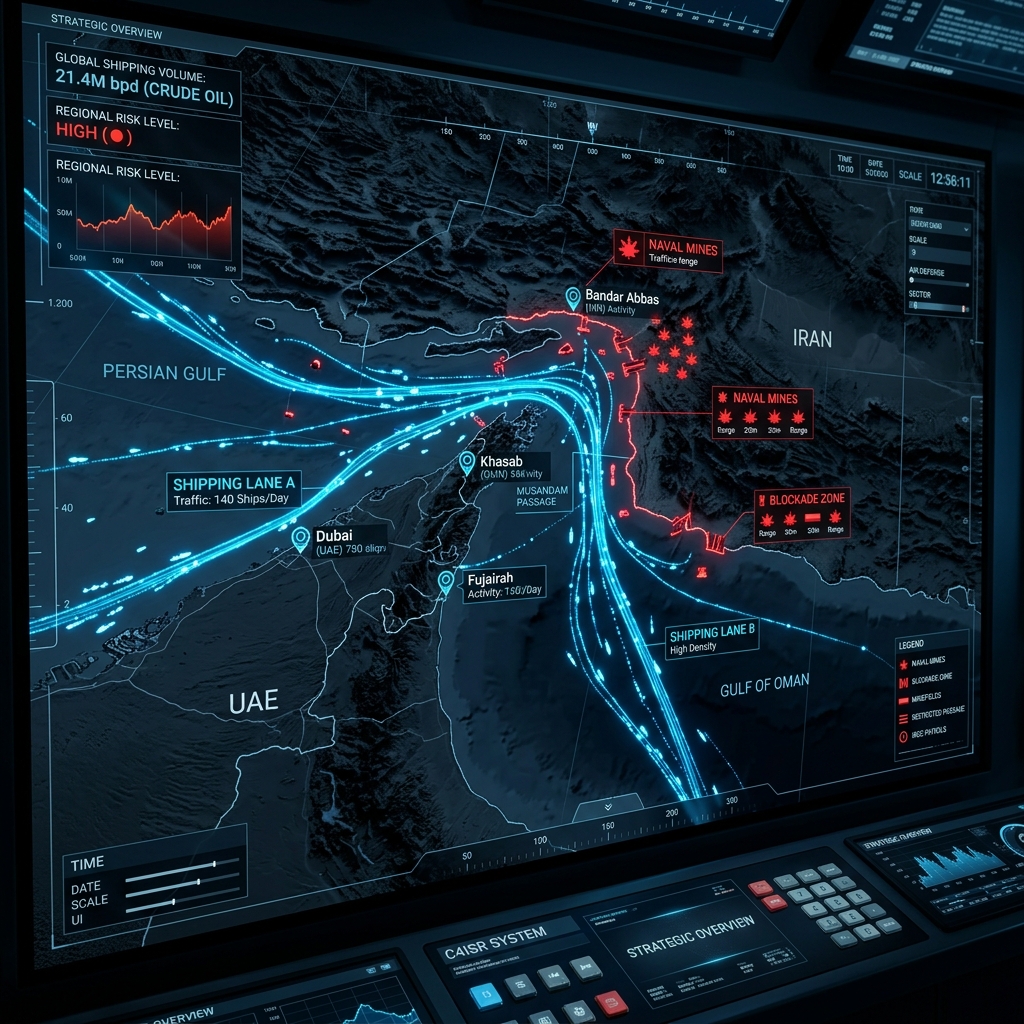
⚓ Hormuz Strait Security Estimator
Strategic projection for coastal neutralization and maritime security corridor enforcement.
⚡ Quick Deployment Presets
📊 Strategic Outcome Envelope
📦 Strategic Magazine Dashboard
🌍 Regional Force Context (May 4, 2026 Update)
| Unit / Element | Combat | Support | Status |
|---|---|---|---|
| Current Regional Force | 12,000 | 38,000 | Deficit: 15k |
| Surge Contingency (Mar 27) | +10,000 | - | COMBAT SURGE |
| Net Deployed (Surge-Adj) | 22,000 | 38,000 | Ratio 1:1.7 (Low) |
| Theater Requirement | 25,000 | 40,000 | 65,000 Total |
- Project Freedom: U.S. forces officially "guiding" stranded neutral vessels (May 4).
- Ceasefire Fragility: Iran warns U.S. "interference" violates current ceasefire terms.
- Support Gap: Logistical imbalance detected (Ratio < 2.0).
- "Toll Booth" Regime: Iran enforcing entry north of Larak Island; U.S. counter-blockade remains.
Operational Support & Air Cover
📑 Systemic Risk Architecture & Methodology INTELLIGENCE GRADE v2.4
📈 Phase-Transition Modeling
Sigmoid Tipping Points: Traditional linear models fail in high-intensity conflict. This model utilizes Sigmoid (S-Curve) functions to simulate market "snaps." Economic damage remains dormant until the Hormuz Threshold is reached.
Hysteresis Recovery: Incorporates a recovery lag post-kinetic operations, accounting for infrastructure damage and the Sulfur/Semiconductor Chokepoint effect.
🛡️ Stochastic Tactical Depth
Magazine Depth Decay: Simulates the exhaustion of defensive interceptors (Patriot/SM-6). Success Probability decays over a 12-day window (D+12) to reflect logistical realities, including sortie rates from USS Tripoli-based F-35Bs.
Confidence Envelopes: Bars display a 90% Confidence Interval to account for "Black Swan" events that traditional point-estimate models ignore.
📚 Data Sources & References
| Operational Detail | Primary Source |
|---|---|
| Naval Chokepoint Doctrine (2026) | U.S. Naval Institute (USNI) |
| Magazine Depth Research | CSIS Missile Defense Project |
| Asymmetric Swarm Warfare Logics | U.S. Naval Institute (USNI) |
| Chokepoint Security & Carrier Vulnerability | Nick Reynolds (Royal United Services Institute) |
| Global Energy Elasticity Reports | IMF World Economic Outlook |
| Project Freedom Launch Timeline | The Hindu (Live Updates) |
| Iran-US Military Standoff | The Guardian (Live) |
| Ceasefire & Reopening Terms | ICIS News |
| Geopolitical Impact Briefing | UK Parliament Research |