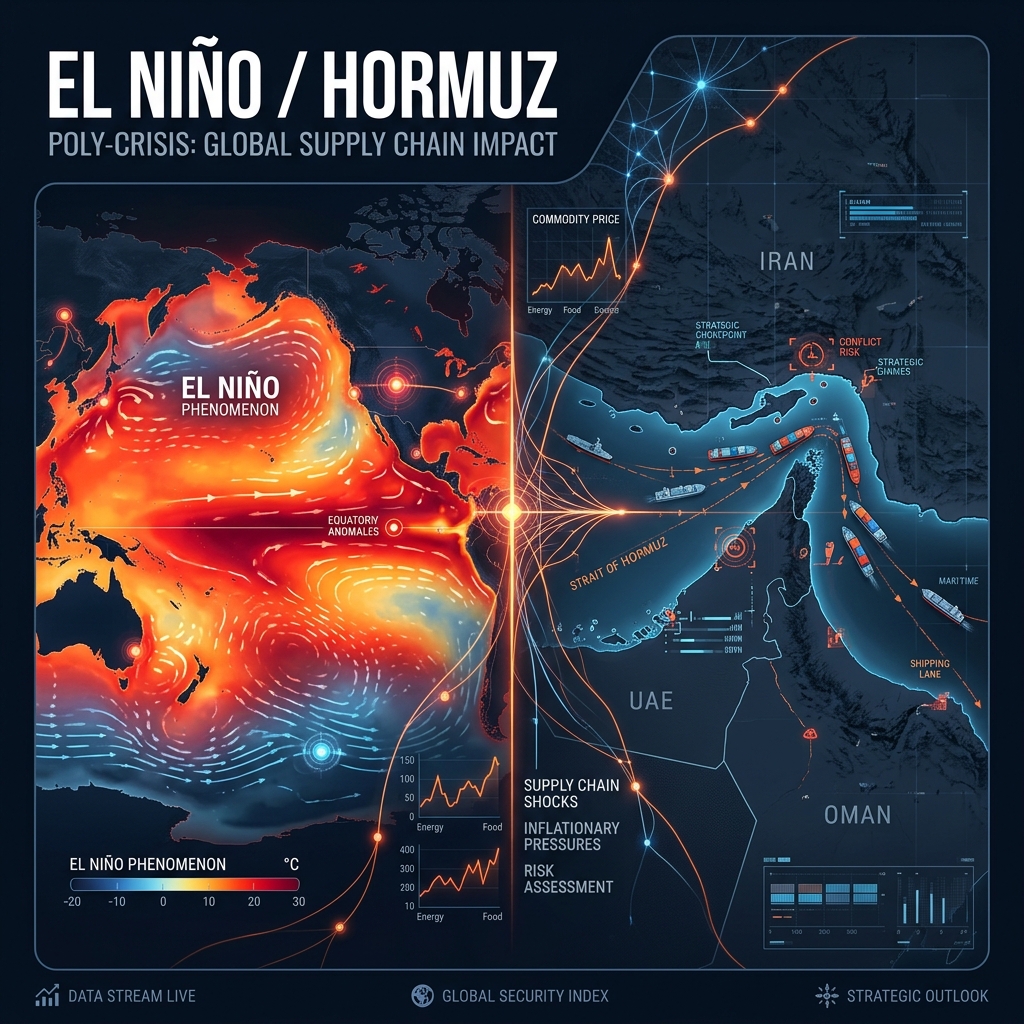
🌪️ El Niño & Hormuz Bottleneck Simulation
Modeling the "Bottleneck Cascade": The convergence of the 2026 El Niño event and the closure of the Strait of Hormuz.
🌡️ What is El Niño? Climate Driver
El Niño is a periodic warming of sea-surface temperatures in the central and eastern equatorial Pacific Ocean, occurring every 2–7 years. It disrupts global weather patterns for 9–12 months.
- Droughts across South Asia, Southern Africa & Australia → crop failures in rice & maize belts
- Flooding in parts of South America → infrastructure damage & harvest disruption
- Heat stress near-globally → reduced agricultural yields & wildfire risk
- A 1°C rise in global temperature is estimated to reduce world GDP by 12% over 6 years (Bilal & Känzig, 2024)
⚓ What is the Strait of Hormuz? Logistics Driver
A 33km-wide maritime chokepoint between Iran and Oman — the world's single most critical energy corridor. Any closure triggers immediate global energy and food cascades.
- ~20% of global seaborne oil transits here daily (~17–18 million barrels)
- ~25% of global LNG trade passes through, sourced from Qatar & Iran
- ~50% of global seaborne urea (fertilizer) exports are produced in Gulf states and must transit the strait
- Closure forces rerouting via the Cape of Good Hope, adding ~10 days & 30–40% freight cost premium
⚡ Simulation Presets
📊 Systemic Vulnerability Indicators
🌍 Systemic Cascades (March 2026 Intelligence)
| Vector | Impact Profile | Mechanism | Severity |
|---|---|---|---|
| Urea Exports | Qatar/Iran Plants | Direct Petrochemical Shutdown | High |
| LNG Supply | 25% Global Trade | Hormuz Transit Halt | Moderate |
| Crop Yields | Rice & Maize (S. Asia) | El Niño Precipitation Shift | Severe |
| Shipping Reroute | Cape of Good Hope | +10 Day Delivery Lag | Active |
Standard models often miss the "chemical cascade." Closure of the Strait of Hormuz shuts down Qatar and Iran's urea plants, rippling from petrochemical feedstocks directly into the cost of global crop production, coinciding with El Niño harvest failures.
📑 Methodology: Multi-Driver Poly-Crisis Model
This simulation integrates research from the Kiel Institute (2026) and Bilal & Känzig (2024) to model the non-linear interaction between climate shocks and logistical chokepoints.
- Climate Multiplier: Incorporates the finding that a 1°C rise in global temperature reduces GDP by 12% over 6 years due to persistent productivity declines.
- Logistical Chokepoint: Models the halt of 20% of global oil and 25% of LNG, specifically calculating the urea/fertilizer deficit from regional petrochemical hubs.
- Welfare Disparity: Developing nations face losses 10–20x larger than the US due to dependency on imported energy and nitrogen-based fertilizers.
📚 Data Sources & References
| Source | Key Insight |
|---|---|
| Bilal & Känzig — NBER Working Paper 32450 (2024) | 1°C global temp rise = 12% GDP reduction over 6 years; 20%+ in the long run. Core climate multiplier for this simulation. |
| Kiel Institute Policy Brief Nr. 206 (2026) | Hormuz closure cost analysis; ~50% of global seaborne urea originates in Gulf states. Fertilizer bottleneck mechanics. |
| Baker Institute — Maritime Chokepoints & Energy Security (2026) | Maritime chokepoint vulnerability mapping and energy security risk profiles. |
| IMF World Economic Outlook (2025/2026) | Cost-push inflation forecasts and regional sovereign stability projections. |
| LUANAR Working Paper 04/2026 | Economy-wide impacts of oil market disruptions on energy-importing nations (Malawi case study). 10–20× welfare loss multiplier vs. G7. |
| WMO ENSO Outlook (April 2026) | El Niño development forecast: onset May–July 2026, expected to persist through end of year. |
| Wikipedia — 2026 Strait of Hormuz Crisis | Closure timeline from Feb 28, 2026; Pakistan-mediated ceasefire talks ongoing as of April 2026. |